Burnet researchers take out two 2025 ARA abstract awards
Aboriginal and Torres Strait Islander peoples abstract award winner - Dr Divya Raghavan
First Nations people who inject drugs were almost twice as likely to share used needles as non-Indigenous people who inject drugs (27% compared to 15% in 2023.
This highlights the need for culturally safe harm reduction services.
Burnet Institute researchers looked at what makes needle and syringe programs safe, welcoming, and effective for Aboriginal and Torres Strait Islander populations in Australia.
They reviewed existing evidence and found that risky injecting behaviours are shaped by many overlapping factors including:
- High rates of imprisonment, where unsafe injecting can start
- Stigma and discrimination that cause psychological distress and lead to riskier practices
- Limited understanding about how blood-borne viruses spread and how to inject safely
Young people and women were found to be particularly at risk.
“This work is an important first step,” said Burnet research led Dr Divya Raghavan.
"The next steps will involve working in partnership with Aboriginal Community Controlled Health Organisations to co-design, implement, and evaluate needle and syringe program models led by and for community.”
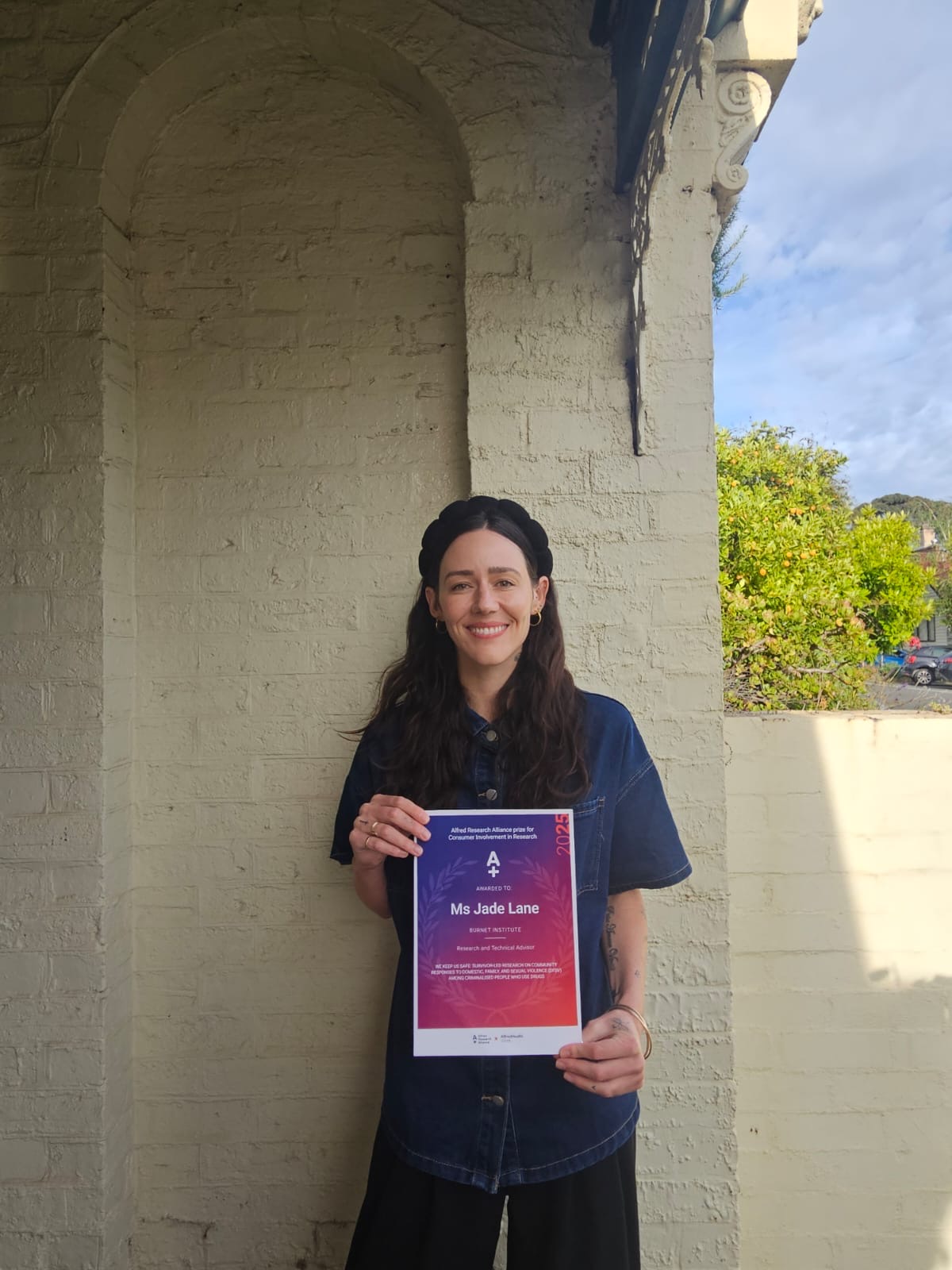
Consumers involvement in research abstract winner - Jade Lane
We Keep Us Safe
This survivor-led project exemplifies deep and meaningful consumer engagement across every stage of research. Designed, led, and analysed by criminalised people with lived experience of drug use and violence, it breaks new ground in a field where trust, access, and representation are often limited. By positioning survivors as co-researchers and decision-makers, the study not only generates valuable new insights but also creates a model for how community-led, non-carceral responses can reshape systems of care and safety for marginalised groups.